Delivery Stages
Understanding the sequential progression of sandwich delivery operations through clearly defined stages from initial order receipt to final completion.
Important Notice
This website is an independent informational resource and is not affiliated with food providers or delivery services. This website does not provide ordering, delivery, or payment services.
The Five Essential Stages
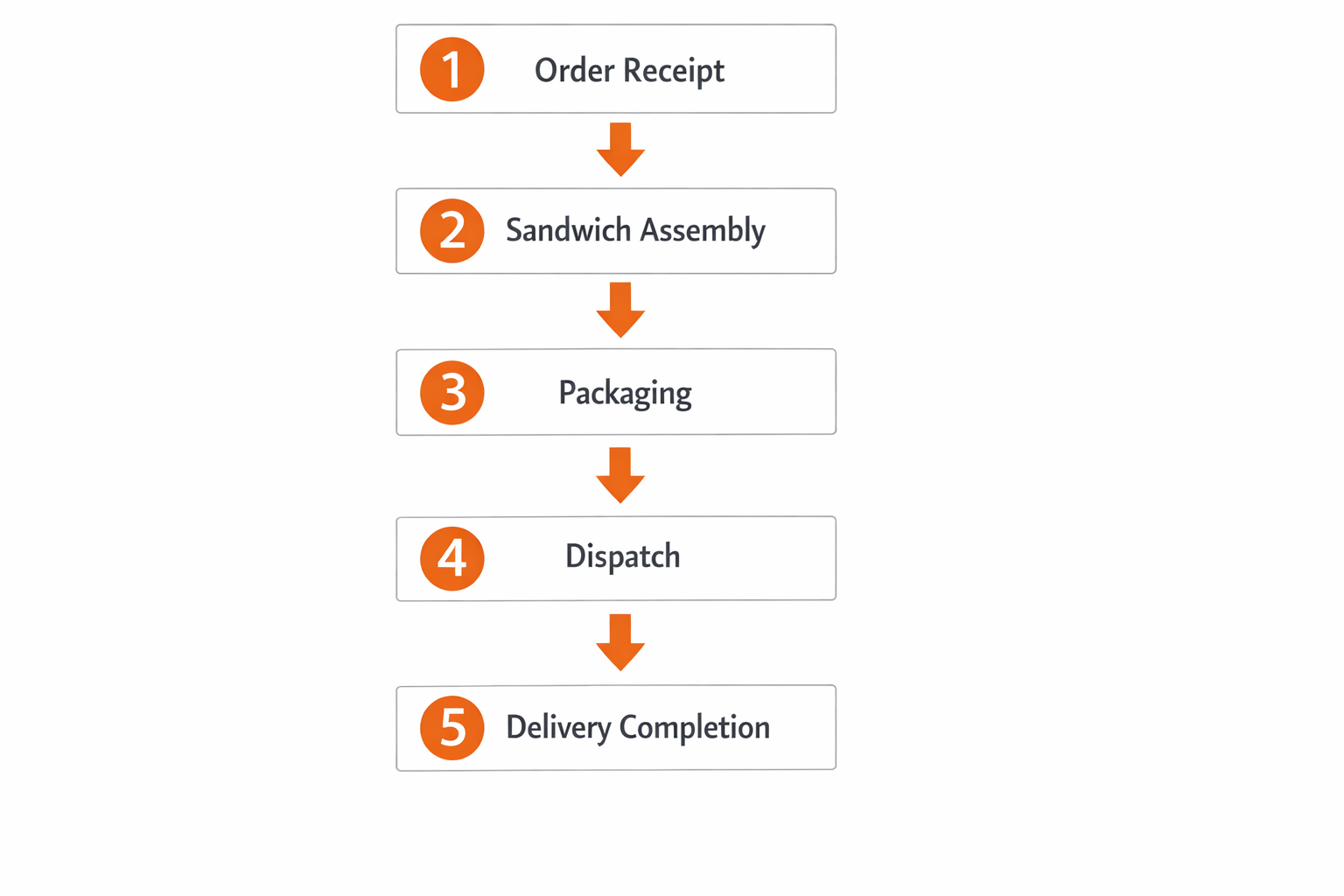
Sandwich delivery operations progress through five distinct stages, each building upon the previous one to create a complete and efficient delivery system. Understanding these stages provides insight into how structured processes enable reliable service delivery.
Each stage represents a critical phase in the delivery lifecycle, with specific objectives, processes, and quality checkpoints. The sequential nature of these stages ensures that proper foundations are established before moving forward, minimizing errors and maintaining service quality throughout the process.
Stage 1: Order Receipt
The delivery process begins with order receipt, where incoming requests are captured, verified, and entered into the system. This stage involves several critical functions including order validation, customer information verification, and assignment of unique order identifiers for tracking purposes.
During order receipt, systems check for completeness of information, verify delivery feasibility based on location and timing, and confirm availability of required ingredients. Any discrepancies or issues are identified and resolved before the order proceeds to the next stage.
Order receipt systems typically include automated validation checks that flag potential problems for human review. This combination of automation and manual oversight ensures accuracy while maintaining efficiency in handling incoming orders.
Key activities in the order receipt stage include:
- Order information collection and validation
- Delivery address verification and geocoding
- Timing confirmation and scheduling
- Special instruction documentation
- Order assignment to preparation queue
Stage 2: Sandwich Assembly
Once orders are validated and queued, the sandwich assembly stage begins. This stage transforms order specifications into physical products through systematic preparation processes. Assembly teams work from detailed order tickets, ensuring accuracy and consistency in each sandwich produced.
The assembly process follows standardized recipes and procedures to maintain uniformity across different preparation staff. Quality control checkpoints are integrated throughout assembly, including ingredient verification, portion control checks, and visual quality inspections.
Timing coordination during assembly is critical to ensure that sandwiches are ready for packaging at appropriate times relative to scheduled delivery windows. Advanced preparation systems optimize sequencing to minimize wait times while maintaining product freshness.
Key activities in the sandwich assembly stage include:
- Ingredient preparation and portioning
- Recipe adherence and assembly procedures
- Quality control inspections
- Temperature management protocols
- Timing and sequencing coordination
Stage 3: Packaging
The packaging stage prepares completed sandwiches for safe transport while maintaining optimal conditions. This stage involves selecting appropriate packaging materials, securing contents to prevent shifting, and implementing insulation measures to preserve temperature and freshness.
Packaging procedures are designed to protect product integrity during transport. This includes selecting containers that prevent moisture loss, using insulation materials to maintain temperature, and securing packages to prevent damage from movement or pressure.
During packaging, teams verify order completeness, attach delivery information labels, and perform final quality checks before handoff to delivery personnel. Packaging also serves as a communication point, displaying handling instructions and delivery details for transport teams.
Key activities in the packaging stage include:
- Package selection and preparation
- Content securing and protection
- Temperature retention measures
- Labeling and documentation
- Final quality verification
Stage 4: Dispatch
The dispatch stage manages the transition from preparation to active delivery. This stage involves assigning packages to delivery vehicles, optimizing delivery routes, and providing delivery personnel with necessary information and resources for successful completion.
Dispatch systems consider multiple factors including delivery locations, timing requirements, vehicle capacity, and traffic conditions. Advanced routing algorithms optimize sequences to minimize travel time and maximize efficiency while meeting individual delivery time commitments.
Communication between dispatch and delivery personnel is continuous throughout this stage, providing real-time updates, route adjustments, and coordination for multiple deliveries. Dispatch serves as the central coordination point for all active delivery operations.
Key activities in the dispatch stage include:
- Vehicle and driver assignment
- Route planning and optimization
- Loading and inventory verification
- Delivery information provision
- Real-time coordination and updates
Stage 5: Delivery Completion
The delivery completion stage represents the final phase of the delivery process. This stage involves physical delivery of packages to designated locations, recipient verification, and confirmation of successful completion. Proper completion requires attention to accuracy, timing, and customer interaction.
Delivery personnel follow specific procedures for package handoff, including verification of recipient identity, confirmation of delivery address accuracy, and documentation of delivery status. Any issues encountered during delivery are reported immediately for resolution.
Upon successful completion, delivery confirmation is recorded in the system, updating order status and triggering any follow-up processes. This confirmation serves as the official record of delivery completion and closes the delivery cycle for individual orders.
Key activities in the delivery completion stage include:
- Location arrival and verification
- Recipient identification and confirmation
- Package handoff procedures
- Status documentation and reporting
- System confirmation and closure
Stage Integration and Coordination
While each delivery stage has distinct objectives and processes, effective coordination between stages is essential for overall system performance. Smooth transitions between stages require clear communication, standardized handoff procedures, and integrated information systems.
Quality checkpoints between stages ensure that problems are identified before they propagate through subsequent processes. This layered quality approach maintains high standards while allowing for efficient problem resolution at appropriate points in the delivery lifecycle.
Understanding the interconnected nature of delivery stages helps organizations optimize their operations. By examining how stages interact and identifying opportunities for improvement at transition points, delivery systems can achieve greater efficiency and reliability.